



For professionals in private practice, practising through a company (SELARL, SELAS) makes it possible to manage the practitioner’s tax position by striking a balance between, on the one hand, the sums paid out as remuneration and dividends and, on the other, the sums retained for reinvestment.
At first sight, it may therefore seem attractive to move these sums up into the holding company dedicated to these professionals, the SPFPL[1]. However, the legal and ethical rules governing medical SPFPLs prevent any investment outside the professional sector of activity.
Investing through the practice company, although possible and tolerated by the professional bodies (Ordres), is not satisfactory either, since non-professionals (spouse, children, etc.) cannot be brought in.
Bruzzo Dubucq therefore offers an alternative method, reserved for certain healthcare professionals in private practice, combining wealth investment from practice income with family succession planning.
REMINDER OF THE RULES ON HOLDING SHARES IN A HEALTHCARE SEL
Majority shareholding: only professionals practising the regulated profession carried on by the professional practice company (société d’exercice libéral, SEL) may hold a majority of its share capital and voting rights.
Minority shareholding: in addition to the persons traditionally entitled to hold a minority interest in an SEL[2] (former practising professionals, heirs of a deceased professional, etc.), Article 70 of the 2023 Ordinance (ordonnance) introduced the possibility for a third party to hold an interest of up to 25%, provided that this is expressly permitted by decree.
The Conseil d’État (France’s highest administrative court)[3] has made clear that this 25% threshold applies only to share capital and voting rights (VR), and not to financial rights (FR), that is, the rights to the SEL’s profits.
In other words, a third party holding less than 25% of the SEL’s share capital and voting rights may receive all (or almost all) of its dividends.
This option is currently available to doctors[4], midwives[5], veterinary surgeons[6] and medical biologists[7].
Pharmacists and dental surgeons, however, are (for now) excluded.
These professionals may therefore opt for an ordinary holding company (an SAS, for example), which will hold up to 25% of the share capital and voting rights of their SEL but which, through the use of preference shares, will receive the vast majority of the dividends.
⚠️ Point to note: the professional bodies concerned remain vigilant about this type of structure, which must not result in any loss of control or independence on the part of the healthcare professional. Our experience shows that purely wealth-driven structures generally raise no difficulty when they have been designed in compliance with the rules of professional conduct.
STEP 1: CONVERT 24.9% OF THE SHARES INTO PREFERENCE SHARES
Separating profit rights from other rights: legally, a single share may carry a proportion of voting rights different from its proportion of profit rights.
In other words, it is entirely possible to separate voting rights from financial rights within a company.
Preference shares: to do so, “preference shares” must be created, that is, shares conferring profit rights that are decoupled from the level of shareholding.
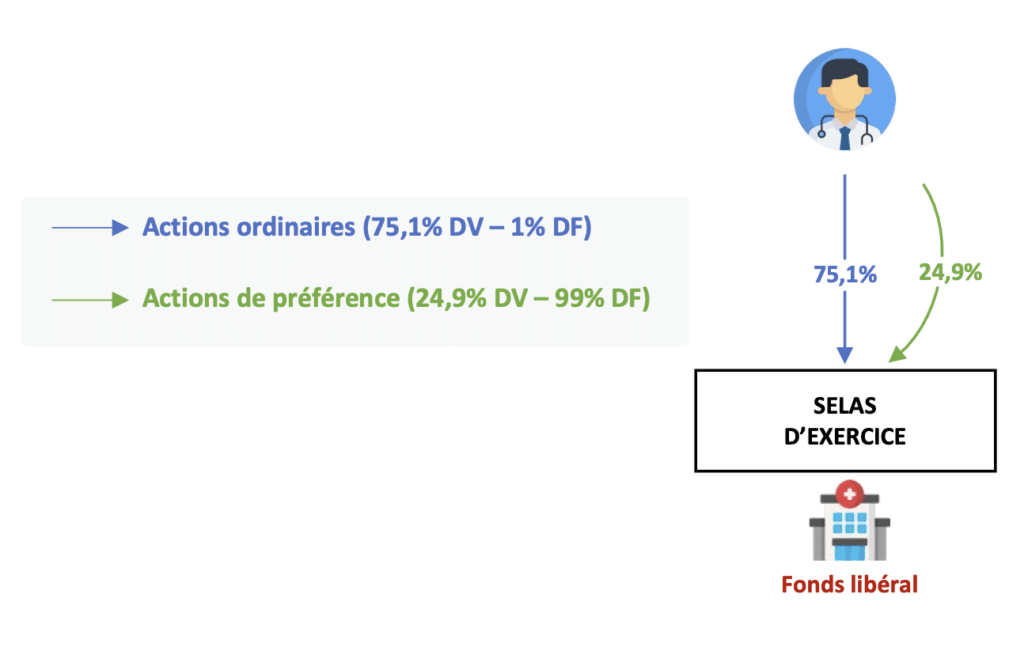
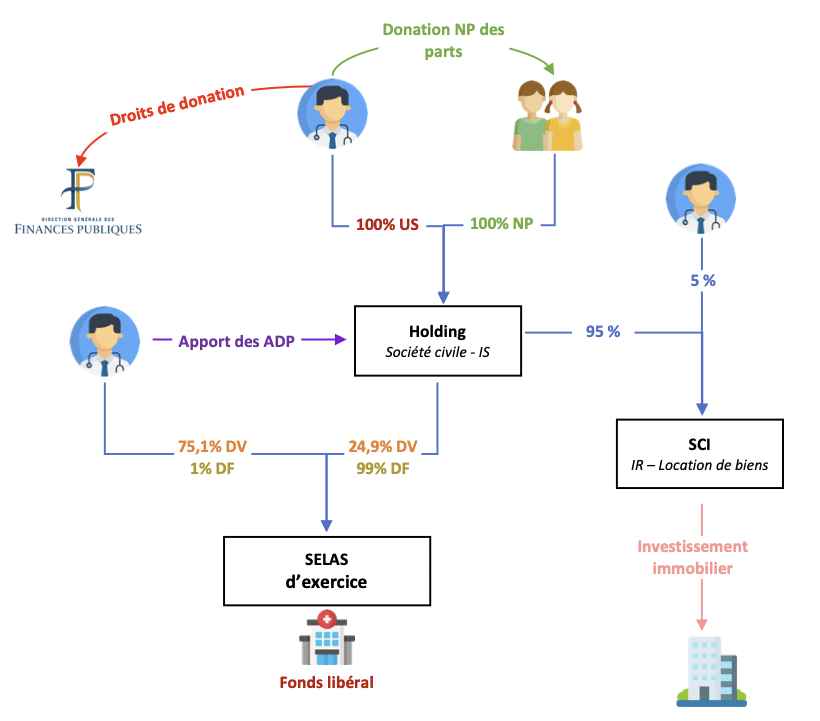
In order to comply with the 25% threshold laid down by the rules of professional conduct, the preference shares will here carry 24.9% of the share capital and voting rights but 99% of the profit rights, so as to maximise investment capacity.
Initially, the healthcare professional will therefore hold two classes of shares:
STEP 2: SETTING UP THE HOLDING COMPANY AND ACQUIRING THE PREFERENCE SHARES
Once the preference shares have been created, the professional can transfer them to his or her ordinary holding company, which is subject to corporation tax.
The holding company will then hold the rights attached to the preference shares, that is, 24.9% of the share capital and voting rights of the practice company and 99% of the dividend rights.
As the holding company is not an SPFPL, it will not be subject to all the constraints that apply to SPFPLs. It will therefore be free to make whatever reinvestments it wishes: financial investments, acquisition of buy-to-let property, equity stakes in businesses, etc.
There are two ways of transferring the preference shares to the holding company:
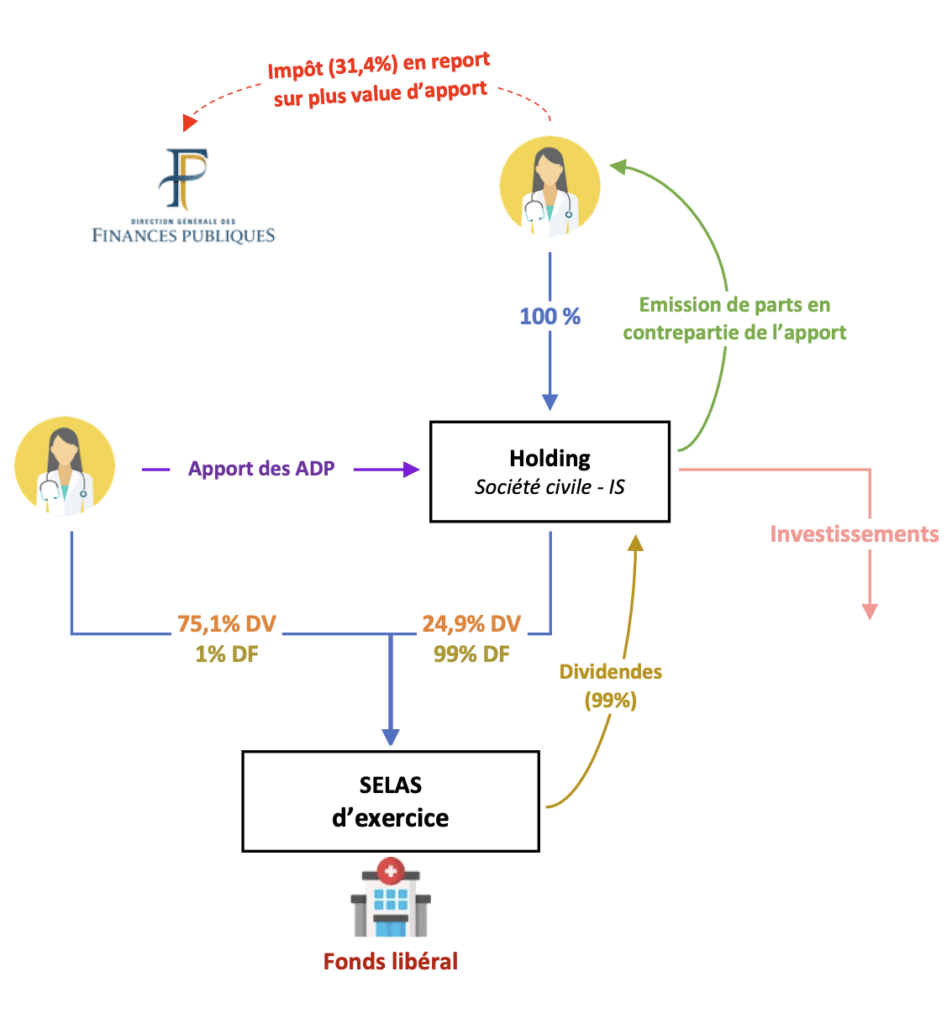
Contribution of the preference shares
When the holding company is incorporated, the professional may contribute the preference shares (referred to as ADP in the diagrams) to its share capital.
In return, the professional will receive shares in the holding company rather than cash. The capital gain arising on the contribution will be subject to tax deferral (report d’imposition)[8]. In other words, it will not be taxed immediately.
Sale of the preference shares to the holding company
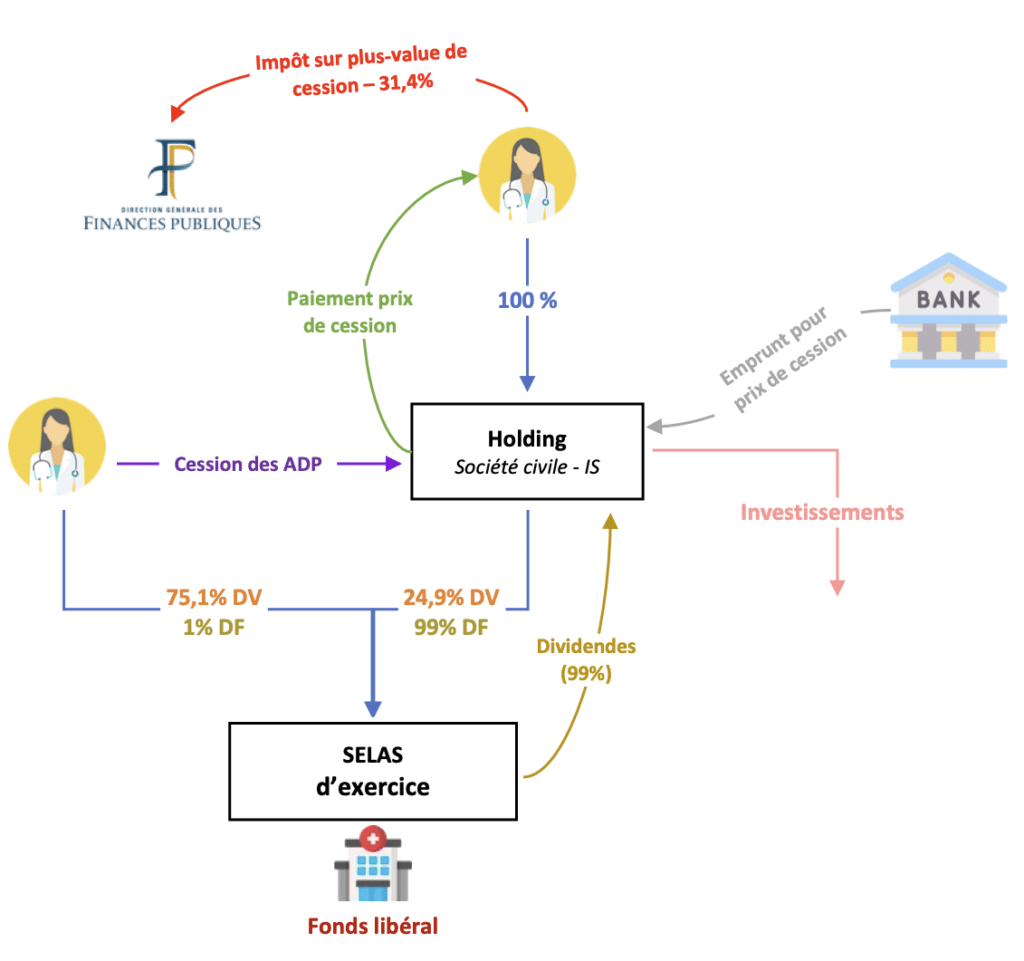
Unlike the previous scenario, the holding company will this time take on debt in order to acquire the preference shares from the professional.
The professional will, for his or her part, be taxed at 31.4%[9] on the capital gain realised, in return for the cash received.
The holding company will then be able to repay its loan instalments using the dividends paid by the practice company in which it holds the preference shares and/or the income from any investments it has made.
In short, the professional may choose to contribute the preference shares to the holding company, an operation that is neutral in economic and therefore tax terms, or to sell them should he or she need cash (for a personal project, for example).
STEP 3: DISTRIBUTING THE PRACTICE COMPANY’S PROFITS
Provided it has opted for corporation tax, the holding company, like any holding company, has the advantage of being able to be funded through the distribution, by way of dividends, of the profits of a practice company it owns, with near-total tax exemption under the so-called “parent-subsidiary” regime.
More specifically, dividends paid by the SEL to the holding company will be almost entirely exempt from corporation tax (CT) in the hands of the holding company[10], from the very first tax year.
This tax is therefore far lower than the 31.4% [11] payable if the SEL’s profits are distributed directly to the professional partner.
The holding company is therefore a far more powerful investment vehicle than the professional personally, since it can reuse the income generated by the professional activity without any tax (or almost none) being payable.
Take the example of a SELARL of anaesthetists that made a profit of €120,000 for its 2024 financial year.
If this profit is distributed to the doctor partner, he or she will owe tax of €37,680 (31.4% x €120,000), leaving a reinvestment capacity of €82,320.
By contrast, if the same profit is distributed to the holding company, it will only have to add back €6,000 (5% x €120,000) to its taxable income, giving CT of €900 (after applying the reduced rate of 15%). Its reinvestment capacity is thus not €82,320 but €119,100 (+45% of available cash).
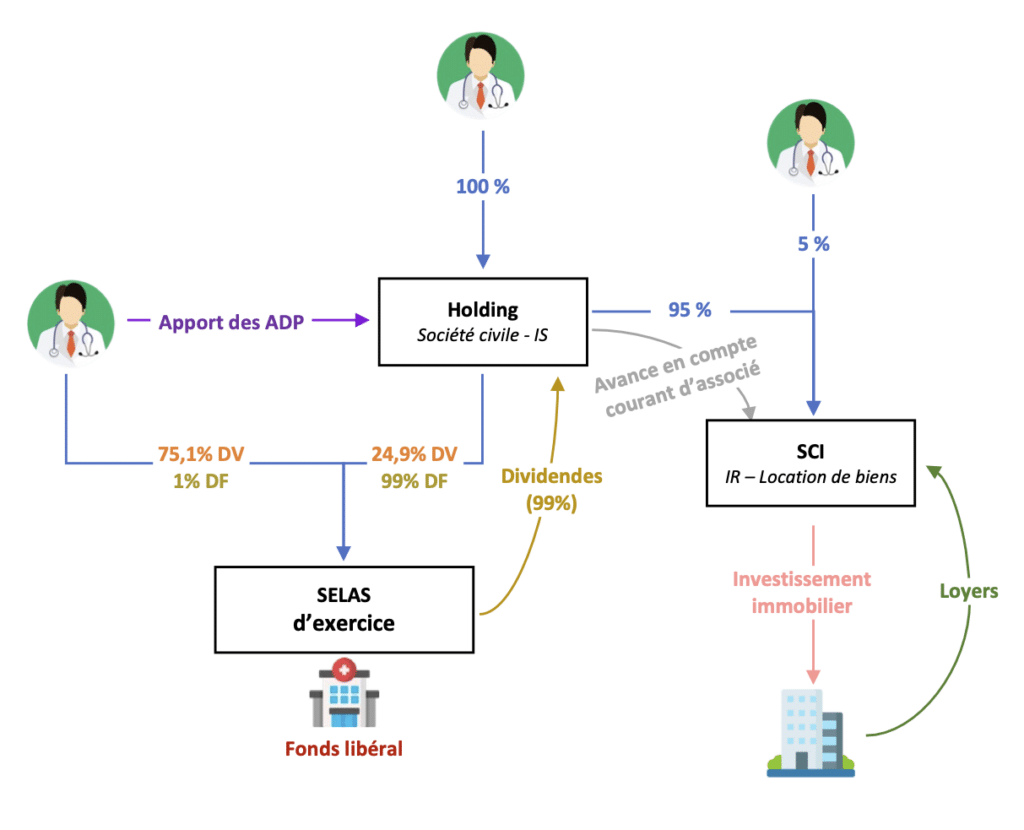
The family micro-holding company can thus reinvest the cash from dividends in any type of investment, including financial or property investments, unlike SPFPLs, which are restricted to property used by the practice (see our article on property investment by the regulated professions).
STEP 4: PLANNING AHEAD FOR THE TRANSFER OF THE FAMILY HOLDING COMPANY TO THE CHILDREN
Again, since the holding company is no longer an SPFPL, there are no restrictions on the identity or status of its shareholders. It will therefore be possible to bring in the spouse and/or the children through the classic structures of gifting the bare ownership.
Where the holding company has taken on debt to buy the preference shares, it would even be preferable to make this gift quickly, since the company would be worth almost nothing (its assets being equal to its liabilities).
The shares whose bare ownership is gifted will thus have a low value, so that the gift will attract little or no tax.
***
For almost 10 years, Bruzzo Dubucq has been advising professionals in private practice on their legal and tax matters, in full compliance with their professional conduct and regulatory obligations.
Contact us and one of our partners will get in touch to discuss your situation and how we can assist you.
[1] Société de Participations Financières de Professions Libérales (financial holding company for the regulated professions)
[2] Article 47 of the Ordinance of 8 February 2023
[3] CE 4e-1e, 2 Dec. 2019, no. 410693
[4] Art. R4113-12 of the French Public Health Code
[5] Art. R4113-12 of the French Public Health Code
[6] Art. R241-96 of the French Rural and Maritime Fishing Code
[7] Art. R6223-64 of the French Public Health Code
[8] Art. 150-0 B ter, French General Tax Code (CGI)
[9] Taxation under the “flat tax”: 12.8% income tax + 18.6% social security contributions (CSG / CRDS)
[10] A share of costs and expenses, equal to 5% of the amount distributed, must be added back to the holding company’s taxable income.
[11] This flat rate applies to the portion of dividends below 10% of the SEL’s share capital. Above that, the dividends distributed are subject to self-employed social security contributions (TNS) rather than to social levies.